DuPage early voting resumes after appellate court restores Brown to ballot; Brown calls challenge ‘baseless nonsense’
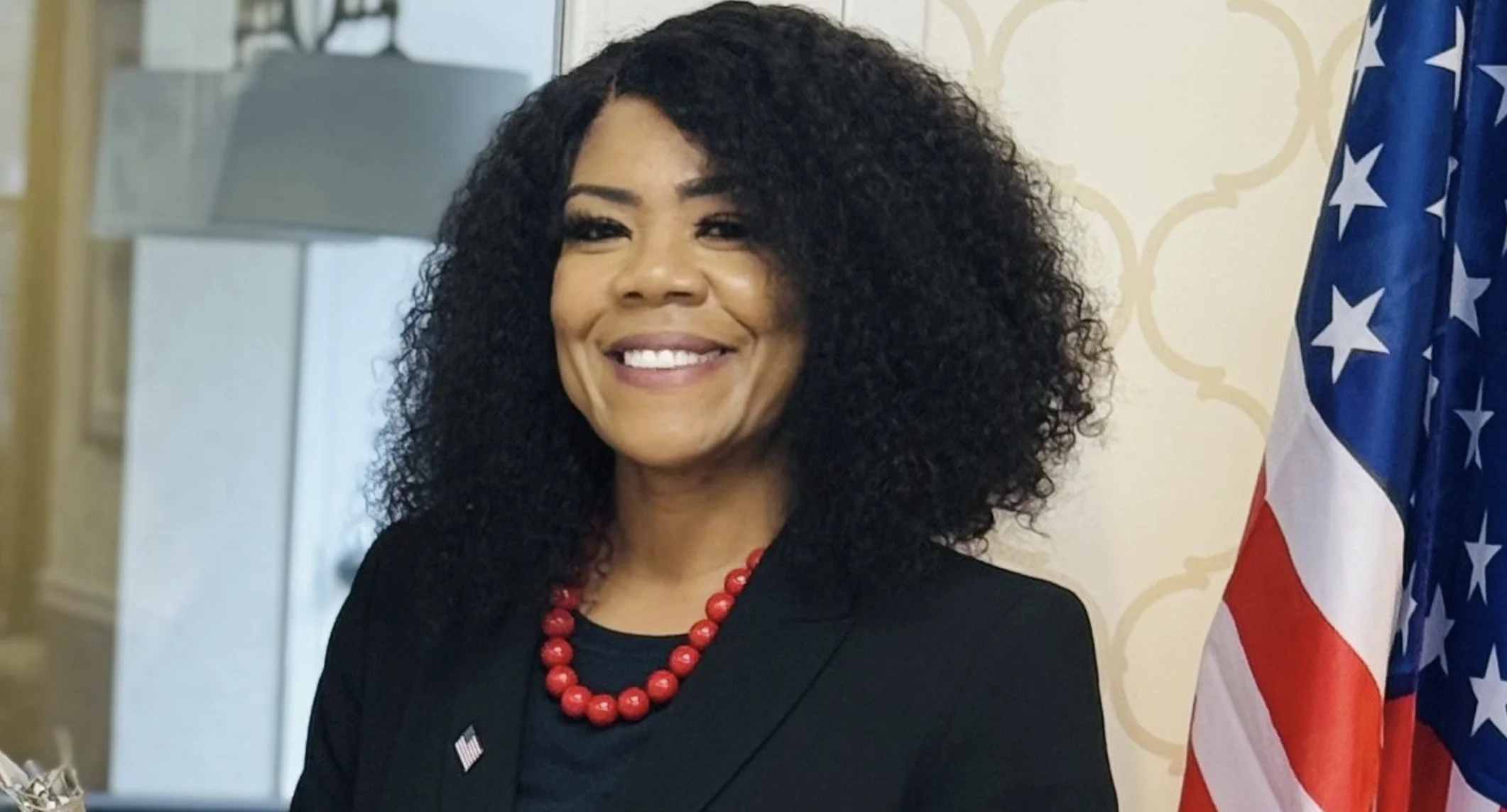
Early voting resumed Monday in DuPage County after a state appellate court reinstated Republican 11th Congressional District candidate Tedora M. Brown to the March 17 primary ballot, reversing earlier rulings that had disqualified her for submitting one fewer valid signature than required.
The decision briefly halted early voting while officials updated ballots.
The 1st District Appellate Court on Friday, Feb. 13, ordered Brown’s name placed on the ballot immediately, overturning decisions by the Illinois State Board of Elections and a Cook County judge who found she submitted 798 valid signatures, one fewer than the required 799.
Despite the temporary halt in voting, Brown said she remains confident in her campaign.
“I definitely believe in democracy and I believe in the system,” Brown told the DuPage Policy Journal. “People don’t think that our state can be saved, but we can.”
She recounted her effort to remain a viable candidate.
“I was able to fight ferociously to make sure that my name was on that ballot because I deserve to be on the ballot,” Brown said. “I appreciate the justices for following the law.”
The ballot dispute caused ripple effects across the 11th Congressional District, which spans eight counties, including Cook, Will, DuPage, Kane, McHenry, Lake, DeKalb and Boone.
Other county clerks kept Brown’s name on the ballot, while Kane, McHenry, Lake and Boone also kept GOP gubernatorial candidate Joseph Severino’s name on the ballot, as both candidates were undergoing appeals when early voting began Feb. 12.
In DuPage County, officials removed Brown’s name from sample ballots after the trial court ruling.
The later appellate decision reinstating Brown forced DuPage County election officials to temporarily halt early voting to update ballots.
Brown, a Palos Park resident and first-time candidate, said she and her attorney contacted the clerk’s office when they discovered the omission.
"We were trying to make sure that my name was on that ballot,” she said.
Brown said she did not speak directly with DuPage County Clerk Jean Kaczmarek while seeking reinstatement, instead working through the county’s legal counsel.
“You can’t really get to her,” Brown said.
Kaczmarek, the first Democrat elected DuPage County clerk in nearly 90 years, is under criminal investigation by the Illinois Attorney General’s Office for alleged misconduct related to election contracts and budget practices. The probe focuses on her approval of more than $229,000 in no-bid contracts for election services.
Brown is one of four Republicans seeking the nomination in the 11th District, along with Elburn Mayor Jeffrey Walter, retired Army Major Michael Pierce and businessman Charlie Kim.
The GOP primary winner will face Democratic U.S. Rep. Bill Foster, who is unopposed in the Democratic primary, in November.
According to DuPage County officials, 742 voters had already cast early in-person ballots without Brown’s name listed. Those votes will still be counted, but voters will not be allowed to recast ballots.
“Yeah, they said it was about 742,” Brown said. “That’s 742 votes that I have lost.”
She also raised concerns about absentee and military voters receiving ballots during the brief period her name was absent.
Brown said she never doubted the validity of her petitions.
“I actually circulated about 85% of my petition sheets myself,” she said. “I was very, very, very secure and confident in the voters.”
After signatures were challenged, Brown said she worked to verify voters’ registrations through county election authorities.
“I proved my burden of proof to show that all of these signers were actually registered to vote at their addresses,” she said.
Brown alleged the petition challenge was politically motivated.
“What happened was I was challenged by one of my fellow (candidates) — Mayor Jeffrey Walter — and we found out that he was the one who actually challenged my petition,” Brown said.
She cited campaign finance filings showing payments to attorneys.
“$7,500 for November and then $7,500 for December to try to get me removed from the ballots,” she said.
Walter has not publicly commented on the allegations. Brown dismissed the objections entirely, calling them “pure baseless nonsense that shouldn’t have went forward.”
Despite being reinstated, Brown criticized Illinois’ election system, questioning early voting procedures and advocating for stricter voter identification and proof-of-citizenship requirements.
“We need to make sure that election integrity is solid,” she said. “There’s a lot of corruption before we even get to the vote.”
Brown emphasized the need for accurate voter registration information.
“We need to get back to making sure voter registration information is correct,” she said. “Our governor signed a law that allows any non-citizen, an illegal immigrant, to get an ID. You can take the ID and register to vote.”
She stressed that verifying citizenship is essential for election integrity.
“The voter registration information is what we need,” Brown said. “We need proof of citizenship. We need to make sure you are a citizen, and we need certified documents.”
Similarly, Republican gubernatorial candidate Ted Dabrowski cited Brown’s case as an example of systemic “chaos” in Illinois elections, pointing to extended early voting, expanded vote-by-mail windows and inconsistent ballot management.
“It's not as simple as one error,” Dabrowski told Prairie State Wire.
“We've got multiple ballots, three different ballots running around in Illinois, and that breaks all the requirements by the Constitution of uniformity of ballots. So you can imagine that there will be voters who will be disenfranchised and candidates who were disenfranchised, and that's a big problem given the election integrity problems we have, not just nationwide but in Illinois in particular, and of course the level of corruption we have here in Illinois.”