Notre Dame Catholic School moving away from tech, AI in pursuit of ‘classical education’ model
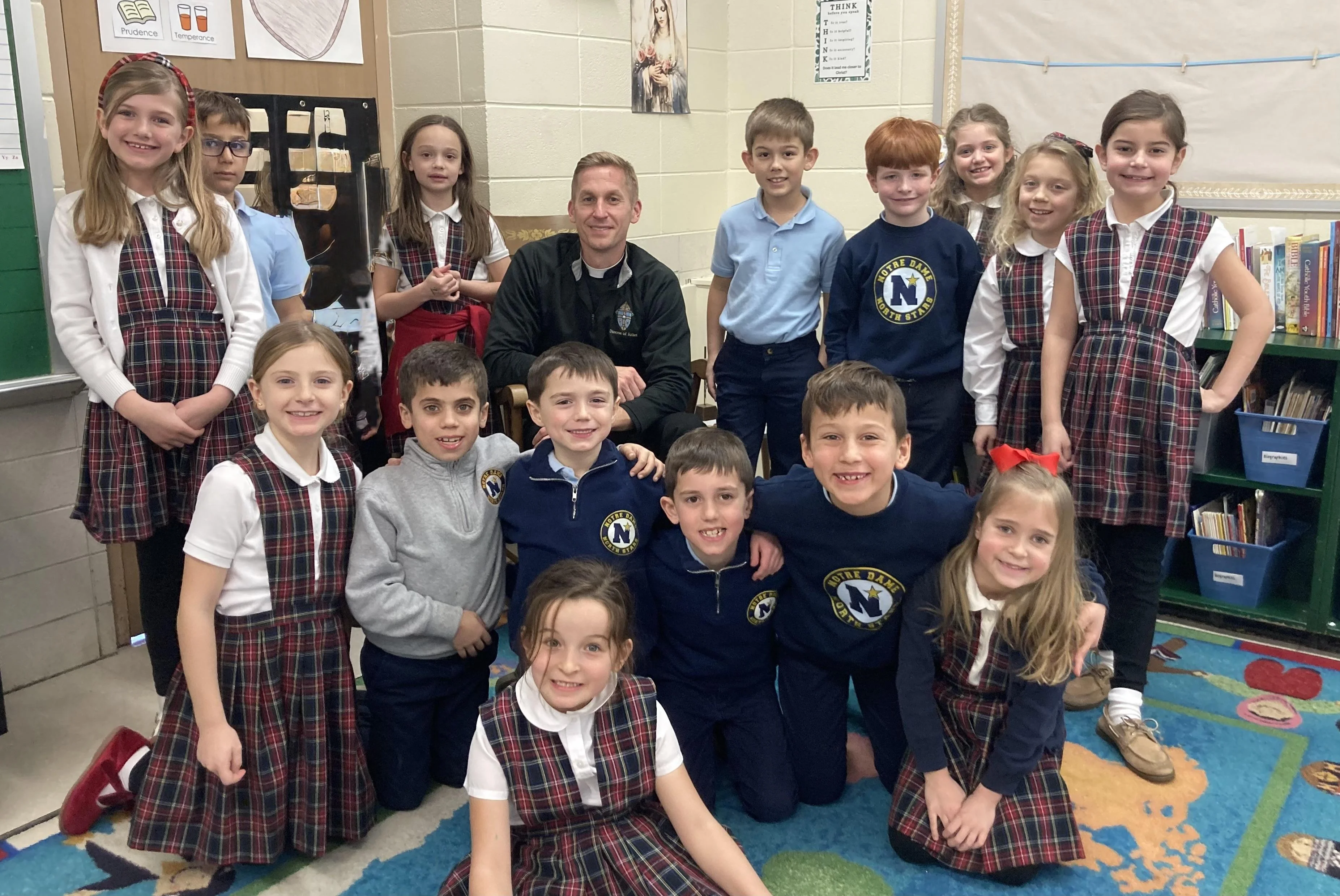
Fr. Mark Bernhard, pastor of Notre Dame Parish, said the parish’s Clarendon Hills Catholic school is shifting to a classical education model that limits technology use and emphasizes face-to-face instruction.
“Education is never just about passing on information; it forms how a child understands truth, beauty, goodness…and ultimately their relationship with God,” Bernhard told the DuPage Policy Journal. “In many ways, modern education has drifted from this deeper purpose.”
The changes come after decades of growing reliance on classroom technology, which some research has linked to lower achievement nationwide. School leaders said instruction will shift back toward face-to-face teaching, with a curriculum centered on inquiry-based learning, Socratic discussion, memorization of poetry, Scripture and literature, explicit phonics, etiquette, leadership opportunities and service.
Bernhard said the change is about helping students succeed, a goal he said has taken on new urgency as students who spent their middle school years in pandemic-era, tech-heavy distance learning begin entering college.
But for Bernhard, the return to a classical model—with Socratic discussion, handwritten classroom work and oral exams—is about shaping character in the students entrusted to the school’s care.
“For many years, education has prioritized efficiency—a shift of emphasis toward grades as a means to college, college as a means to a job, and a job as a means to material success, rather than toward the formation of wise, virtuous, and joyful human beings,” he said. “This can unintentionally communicate to children that their worth is tied to performance rather than to who they are as beloved sons and daughters of God.”
Bernhard said education should shape a student’s inner life, not simply serve as a measure of achievement.
“The Church has always understood education as a path to wisdom and holiness. Classical education returns to that vision,” he said. “By slowing down, asking good questions, and engaging the mind through conversation, memory, and wonder, students are invited not just to learn, but to encounter truth. A classical liberal arts approach, rooted in truth, goodness, and beauty, invites children to discover God, their purpose, and their God-given dignity through learning.”
The school’s return to a classical model comes as educators raise concerns that the misuse of artificial intelligence can easily undermine coursework.
“Across the country, schools are struggling with cheating, over-reliance on technology, and a growing sense that students are disengaged or overwhelmed,” Bernhard said.
ACT scores have been dropping for and as of 2023 were at their lowest levels in 32 years with 40% of high school seniors nationwide not meeting college readiness expectations. This is part of a broader decline in academic achievement since the Covid pandemic.
The New York Post recently reported that of incoming freshmen at the University of California San Diego 1 in 12 students could not do middle school math and that 70% of the school’s latest cohort could not perform high school level mathematics.
In an editorial published in the Wall Street Journal, John J Goyette, Dean Emeritus of Thomas Aquinas College, said that the academic structure today rewards cheating and that rampant AI use is undermining undermining highly technological learning structures adopted by most educational institutions over the past decade, especially during the pandemic years.
Goyette and other critics have stressed a need for a seismic change in educational curriculum, moving back to age-old methods of examination, a call Bernhard has echoed.
“The Church teaches that technology itself is neutral…it can be used for great good or real harm,” Berhard said. “Artificial intelligence can be a helpful tool when used wisely. Our concern is that students may turn to AI before learning how to think for themselves. When complex questions are outsourced too quickly, it can hinder the development of critical thinking, reasoning, and intellectual virtue…especially at a young age.”
According to Study.com, 89% of college students have admitted to using ChatGPT to complete a homework assignment, and 53 percent had turned in an AI-generated essay.
“Students can't outsource thinking to a chatbot when facing live questions,” Sarah Hernholm wrote in a Forbes article on combatting AI misuse among students.
Given the rampant misuse of AI in education many have advocated for stopping online learning altogether, as well as eliminating screens of all kinds from the classroom.
“I already overhear adults and children speak this way: ‘ah, just ask ChatGPT,’” Bernhard said. “This is problematic. A classical education addresses this by emphasizing habits of thought: asking good questions, reasoning through problems, engaging in Socratic dialogue, and learning to express ideas clearly in writing and speech. These skills form students who are capable of using technology wisely, rather than being formed by it.”
The misuse of AI by students since its widespread introduction in November 2022 has led some schools to invest millions of dollars in AI detection software.
However, schools such as Notre Dame Catholic Parish are taking a different approach by returning to the basics.
This shift moves away from a technology-heavy model of instruction and returns to time-tested methods that have formed the foundation of education for centuries, Bernhard said.
Notre Dame Parish’s school is leaning into that shift, returning to in-class, discussion-heavy instruction that emphasizes communication skills and the basics of reading, writing and arithmetic.
Amanda Paul, principal of Notre Dame Catholic School and a mother of three daughters in eighth grade, sixth grade and preschool who all attend the school, is a major part of the effort.
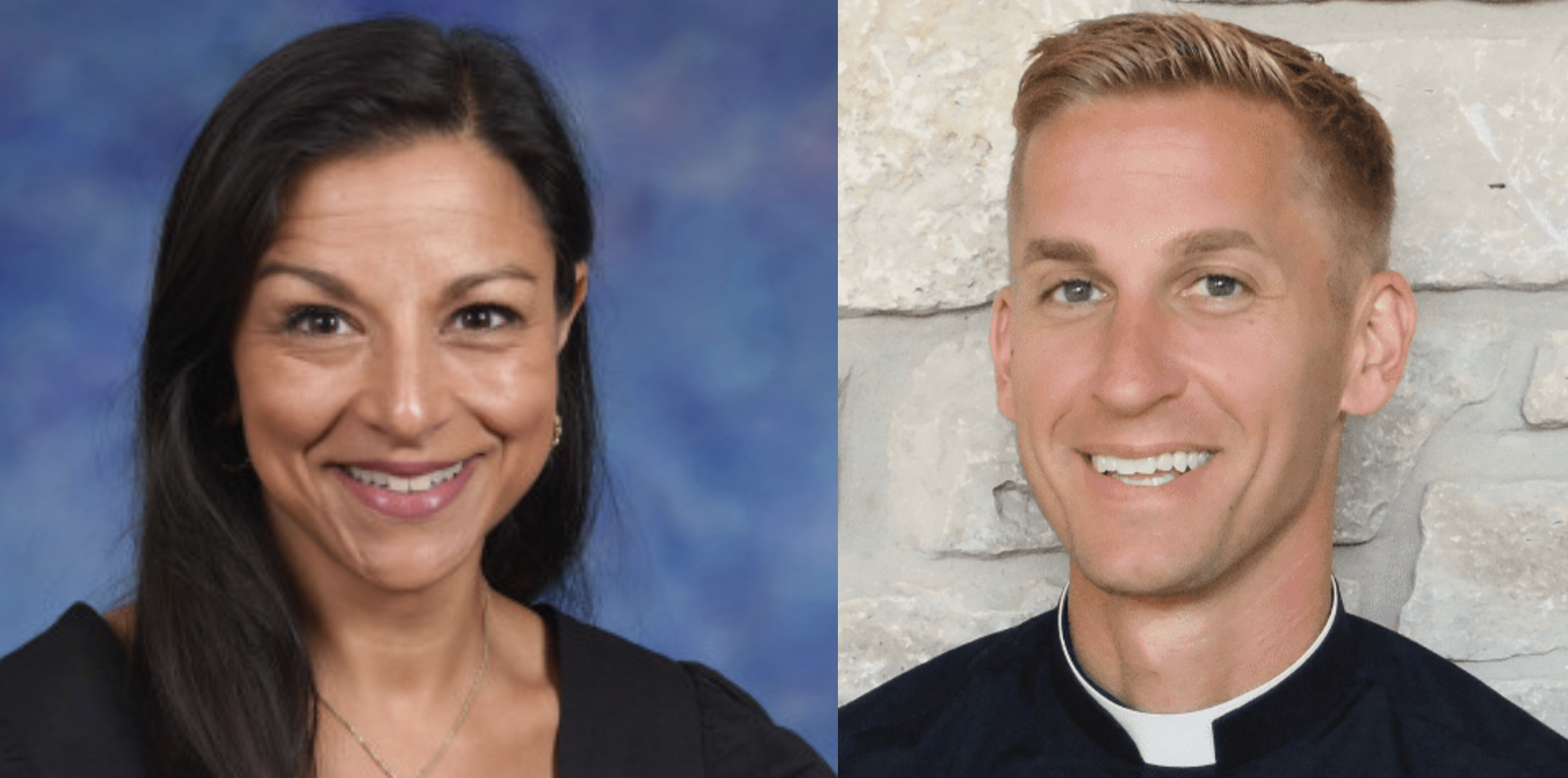
Amanda Paul, Principal at Notre Dame Catholic School and Fr. Mark Bernhard, Pastor at Notre Dame Parish. (Notre Dame Catholic School)
Paul, in her fifth year as principal after serving as assistant principal and teaching at the Notre Dame Catholic School, views the shift toward a classical model as a return to tradition rather than a departure from modern practices.
“I think it's important to recognize that this is not a change from how the Church intended education to be when the first Catholic schools came about,” Paul told the DuPage Policy Journal. “We see this more as a renewal of what the Church intended for our Catholic schools. Schools are one of the biggest missions of the Church and ministries.”
She and school officials said they are emphasizing holistic formation — spiritual, moral and intellectual — aimed at drawing students closer to Christ while supporting parents as their children’s primary educators.
Paul, who previously worked in early childhood and special education in the public school system, expressed concern about trends in education, including heavy reliance on screen-based learning.
She said one-to-one device programs often lead to shortened attention spans, dependency on gadgets, reduced critical thinking and diminished interpersonal skills.
“At the end of the day, children aren't data. We're human beings, and we desire relationship information,” Paul said. “And so we are in that. I just feel so fortunate to be a part of Catholic education in the sense that we can focus on the child. We can focus our relationship with God in seeking truth, beauty, and goodness in our world and in what God has created and given us. This is the deeper purpose, right?”
Paul highlighted the importance of unstructured play, outdoor recess, conversation, “grit” and handling disappointment, skills she said are essential for human development.
She argues that excessive screen time and gamified educational apps prioritize immediate gratification over deep learning and retention.
“As a parent, I feel for parents and the challenges we're facing in the lack of support from the culture and community," she said. “It’s really scary the way the computer or the phone can influence our children to just as simple as not talking to us. I don't know if you've seen any of that research, where the influencers or even AI teaches the children just to entrust and have the conversation here on the computer with them and not their parents.”
Parents, she said, need community support amid cultural pressures and the school aims to reinforce family values through prayer, shared experiences and real human connection.
Paul said the return to classical education methods at Notre Dame Catholic School will bring students greater joy, keeping them closer to God and their families.
“I think that's really important to get them thinking outside of themselves, about the community and the purpose of living and being together is to support one another,” she said. “It's not just all for what I need or what I can gain from this situation. And the thing of it is, is when you focus on all these things, the ability to do well on a standardized test comes naturally.”