Former State Rep. Ives on husband mistakenly sent unemployment payments: ‘Complete incompetence’

The Illinois Department of Employment Security (IDES) has not responded to requests for comment after mistakenly issuing unemployment benefits to the husband of former state Representative Jeanne Ives, Paul—who is fully employed and did not file a claim—a case Ives says highlights ongoing issues at the agency.
Ives said her husband received a letter from IDES stating he was eligible for unemployment benefits due to a layoff, despite no separation from employment and no claim being filed.
She said the experience has shaken her confidence in state government operations.
“After you hear about this happening and then it happens to you personally, it just further gives you zero confidence that there's anything that runs correctly in this state,” Ives told the DuPage Policy Journal. “There's no checks and balances. Money is flying out the door with nobody accounting for where it's going and if it's properly being given out. So this is very concerning.”
According to Ives, the payments were automatically deposited into her husband's bank account and were scheduled to continue through Dec. 27, 2026. She said she has not received guidance from IDES on how to correct the issue.
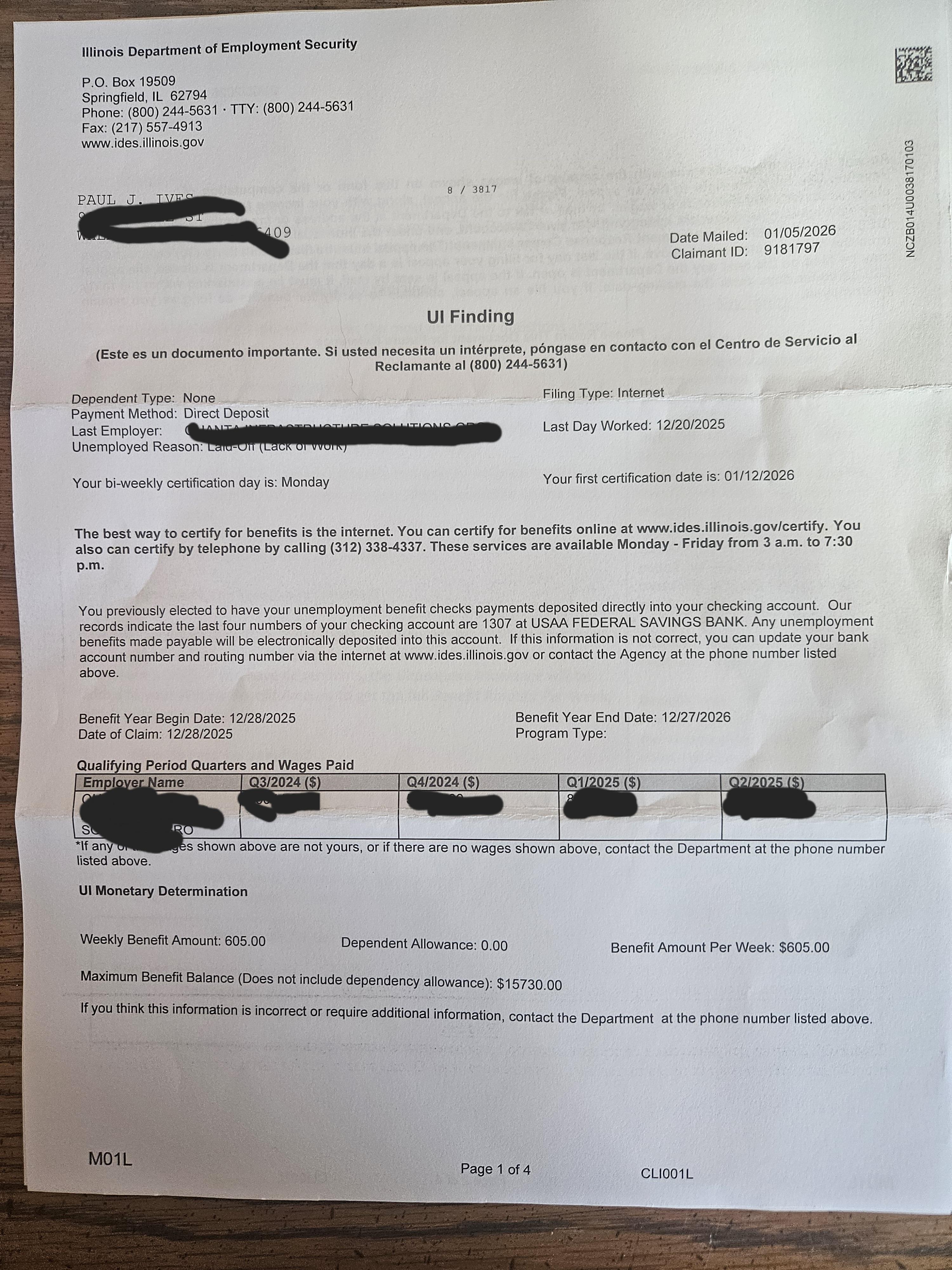
A letter from IDES to Jeanne Ives’ husband shows he was deemed eligible for
unemployment benefits and issued payments despite being fully employed and
not filing a claim. (Jeanne Ives)
The incident comes after a 2023 Illinois Auditor General report found that IDES improperly paid an estimated $5.24 billion in unemployment benefits between fiscal years 2020 and 2022 during the COVID-19 pandemic.
The audit said the agency weakened or suspended key identity and fraud controls to speed payments, leaving the system vulnerable to abuse. Auditors said only a small fraction of the improper payments were ever stopped or recovered.
Rapidly changing federal guidance, new programs, staffing shortages, system failures, and poor planning compounded delays and errors. The Auditor General found IDES lacked adequate internal controls to balance fast payments with fraud prevention.
“This is ridiculous,” she said. “We run sophisticated financial systems internationally, and IDES can't get this right. Complete incompetence. They don't want to get it right.”
Ives said the family initially believed the issue would resolve itself since no claim had been filed, but the automatic payment raised concerns. She said efforts to contact IDES and immediately return the money have not resulted in any response.
“The other thing is that there's also no immediate response, within a few days, from the agency about how to correct this,” she said. “And this could create a huge tax problem for us. The money is put into an escrow account. We want to pay it back. But in the end, we could end up with a tax complication by them saying that we got money when we intend to give it back, and we can't do anything about it.”
As of publication, IDES has not responded to requests for comment.
The agency’s Information Strategy Director and Public Information Officer, Rebecca Cisco, did not reply to interview requests sent by email, text message, and a follow-up phone call from the DuPage Policy Journal.
Requests for comment sought explanations for what could trigger an eligibility determination and direct deposit without a filed claim, what safeguards exist to prevent payments to actively employed individuals, how recipients can return funds issued in error, and what changes have been implemented since the Auditor General’s report to strengthen oversight.
Ives said her husband's only interaction with the unemployment system occurred about six years ago, when his former employer was acquired and he collected benefits for four weeks while transitioning to a new job.
The agency’s silence, combined with detailed audit findings and new firsthand accounts, has renewed scrutiny over whether vulnerabilities exposed during the pandemic have been addressed within Illinois’ unemployment system.
The incident gained broader attention during a Facebook discussion between Ives and Kirk Allen of Edgar County Watchdogs, in which both cited personal experiences with erroneous unemployment payments and described difficulty notifying IDES or returning the funds.
Allen said he received an unsolicited debit card despite never filing a claim.
“I received a visa credit card from the unemployment office for a benefit," Allen said in the Facebook Live discussion. “And I'm self-employed. I've never filed for unemployment. And it took about two weeks to get an actual return phone call to the fraud division. And they said, 'yeah, this happens all the time. Just go ahead and cut it up and don't worry about it.'”
Allen then highlighted findings from the Illinois Auditor General’s report on IDES fraud.
“481 deceased individuals received as much as $6 million and then incarcerated individuals got $40.5 million. Not to mention all the other fraud, but it was well over $2 billion in fraud,” he said.
He also noted recent federal findings of unemployment fraud in Minnesota, estimated at up to $9 billion over the past decade.
“Hopefully the authorities will pick up on this kind of stuff and realize we make Minnesota look like child's play in their care centers,” he said.